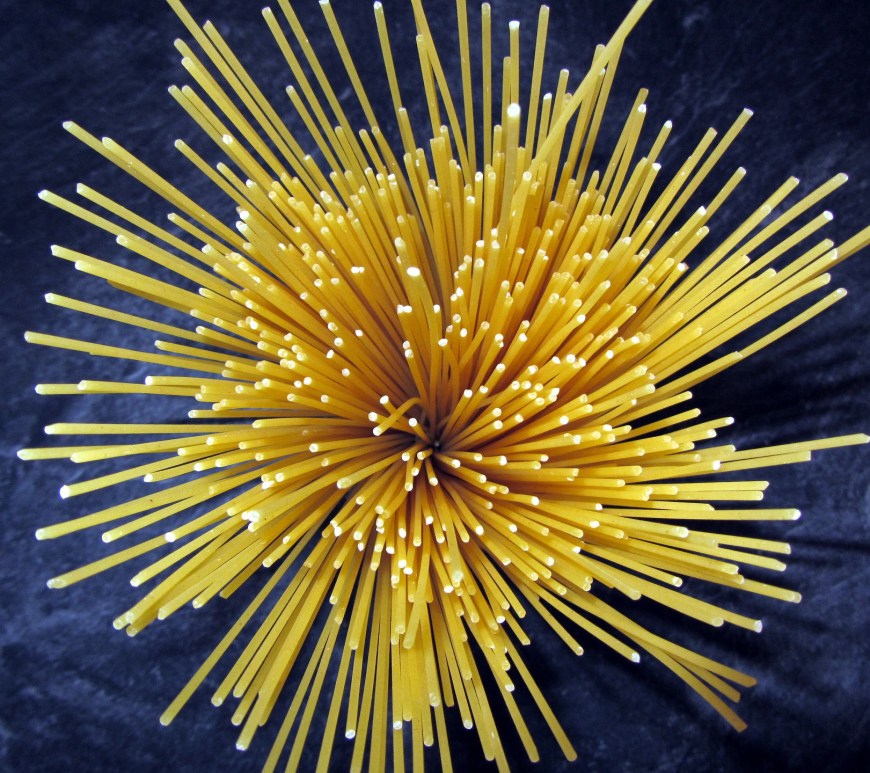
Spaghetti never break in two

If you grab a piece of spaghetti and bend it further and further, it will eventually break. It won’t just break in two, though: most likely it will break in three or more pieces. What sorcery is this?


Don’t believe me? Be a scientist: try it yourself!

Continue reading “Spaghetti never break in two”

Theoretical donuts and quantum computers: the Nobel prize 2016

So it wasn’t gravitational waves after all: the Nobel prize for physics went to David Thouless, Duncan Haldane and Michael Kosterlitz. That’s the easy part. The motivation needs a little unpacking: For theoretical discoveries of topological phase transitions and topological phases of matter. We all know and love a few phases of matter: solid, liquid and gas (maybe plasma if you want to get kinky). … Continue reading Theoretical donuts and quantum computers: the Nobel prize 2016

What if gravitational waves don’t win the Nobel prize?

Most predictions for the winners of this years Nobel prize for physics point to the biggest piece of science news we’ve had: gravitational waves. I’ll go out on a limb and say that I’m not convinced they will. Don’t get me wrong: I’m a great fan of team LIGO’s work, too. The discovery of gravitational waves was incredible, but so was the Higgs boson. LIGO … Continue reading What if gravitational waves don’t win the Nobel prize?

How many times can you fold a piece of paper?

Some time ago I came across a fun article. I got curious, and embarked on a journey that took me to the source of a famous internet myth and even to explore what it means to be a physicist. But let’s not get ahead of ourselves. The article was about the myth that it’s impossible to fold a piece of paper more than 7 times, … Continue reading How many times can you fold a piece of paper?

No country for plasma TVs

There’s a beautiful country, with forests and deserts, vast salt lakes and tall mountains. A country where driving can be mortally dangerous. A country where your new plasma TV won’t last very long. ¡Bienvenidos a Bolivia! A plasma screen is basically a bunch of small neon lamps. They work by passing an electric current through a container full of gas (like, you guessed it, neon!): … Continue reading No country for plasma TVs