
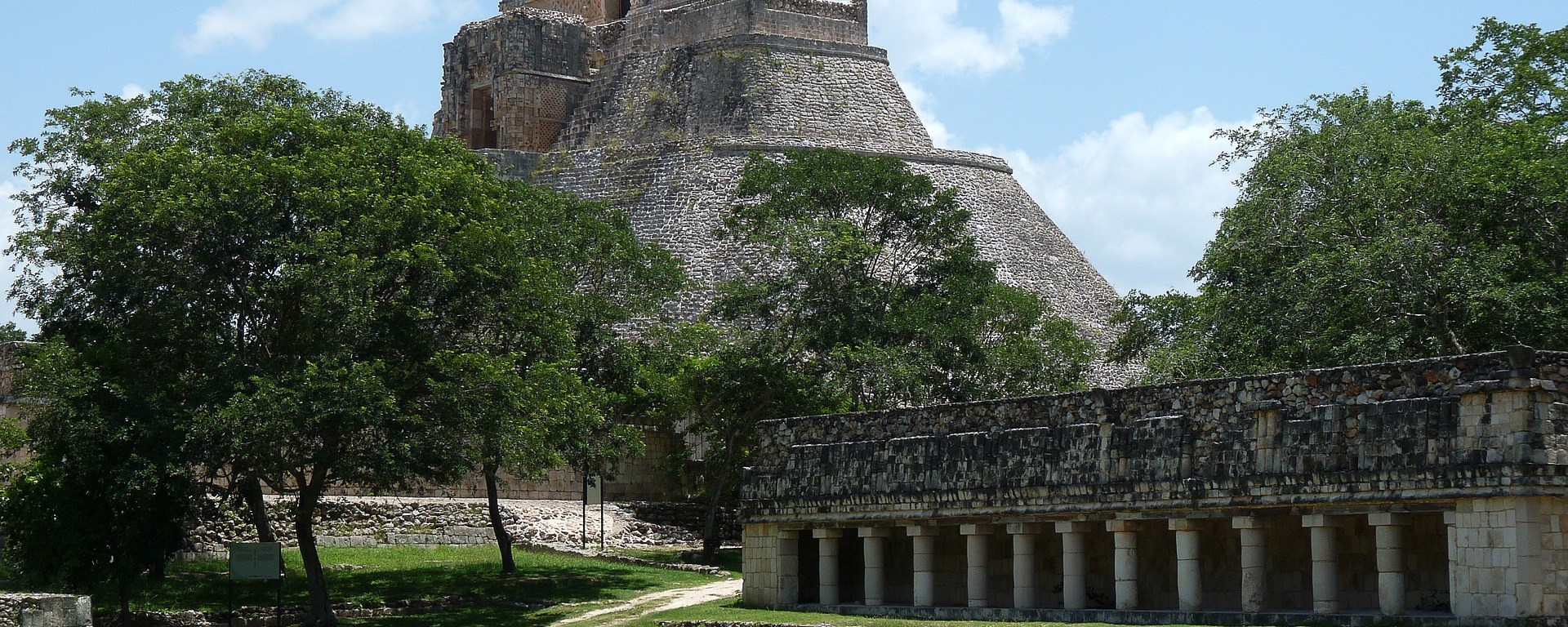
Thousands of previously unknown Maya structures reveal interconnected cities, defensive walls, landscape architecture, plus space and organization indicating millions of people living there. And they were found thanks to physics.
After the fall of the Maya civilization, many ruins were rapidly covered by the thick tropical jungle. Now enormous structures and even entire cities are practically invisible, even when standing right next to them.

Even from a bird’s eye view, the ruins remain hidden underneath the dense jungle canopy. That’s when physics swoops in to help. With lasers!
For example, the recent discovery of a Mayan megalopolis was made possible by LiDAR: the Light Detection And Ranging. The basic idea behind the same as a bat’s sonar, but with lasers: shoot a brief, narrow laser pulse and time how long its scattered reflection take to come back. Multiplying that time by the speed of light you get how far away it hit.

To find the Mayan ruins, drones and planes flew over a swath of Guatemalan jungle, shooting multiple laser pulses per second. Their narrow focus allowed scientists to pinpoint where they bounced off: some stopped at the top of the canopy, some went through a few layers of leaves, some even get all the way to the ground.
//commons.wikimedia.org/wiki/File:Flying_Through_LIDAR_Canopy_Data.webm?embedplayer=yes
Collecting data from several angles, scientists reconstruct a virtual 3D model of the forest.
From that model one can then strip away trees and foliage and look at the ground below. As you can see in this amazing picture, lots of the “ground” beneath the trees actually looked suspiciously like structures—walls, pyramids, and causeways.

Upon analyzing the images, expert archaeologists were thrilled to find a sprawling metropolis, which seems to have housed millions of people, completely changing our understanding of the size of this ancient civilization.
If you want more
- LiDARs are also the core of some specimens of a somewhat less popular device: the speed camera.
- The National Geographic documentary “Lost Treasures of the Maya Snake Kings” dives deep in the discovery and its archaeological significance
Cover photo: CC0 jacqueline macou/pixabay
 PhysicalLove