
Among lightsabers, spaceships, and grandiose special effects, Star Wars: The Last Jedi also offers some reflection on who heroes are, and what part they play in history. And it made me think about my science heroes: Nobel prize winners.
The Last Jedi shows quite explicitly that you don’t become a Rebellion hero trying to be the new Luke Skywalker. Much like you don’t become a great scientist by trying to become the new Marie Curie (although she’s pretty badass also as a zombie):
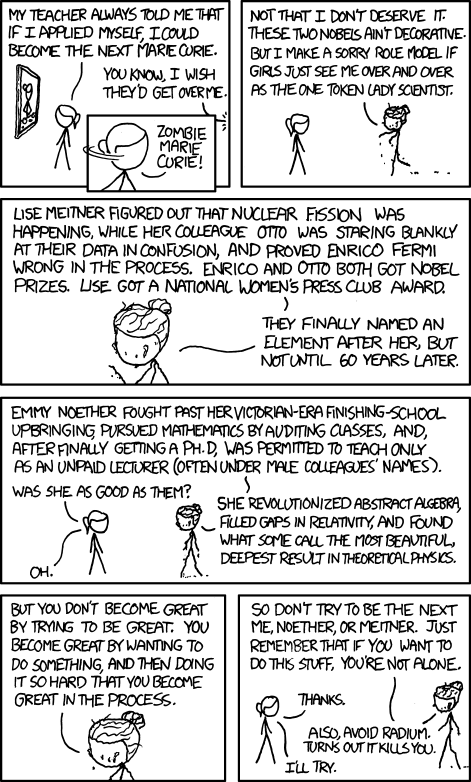
Nevertheless, heroes represent something, and the Nobel prize–explicitly or not–makes heroes of the authors of great scientific enterprises. There has been a discussion for a few years about how this choice is made, and the problems it entails. One of them is that the prize is awarded to up to three people per discipline per year, like a century ago. It made no sense then–because every discovery rests on centuries of previous research–and it makes even less sense now. The time when a person could singlehandedly discover several chemical elements or come up with the entire theory of relativity is over. Modern great discoveries (gravitational waves, the Higgs boson) happen in experiments so large they were unimaginable 100 years ago, thanks to the work of thousands of people.
Isn’t it unfair to credit just three “LIGO heroes” for the effort of a collective?
But giving credit for collective works is but one of the issues: of 206 Nobel laureates in physics up to 2017, only two were women. TWO.
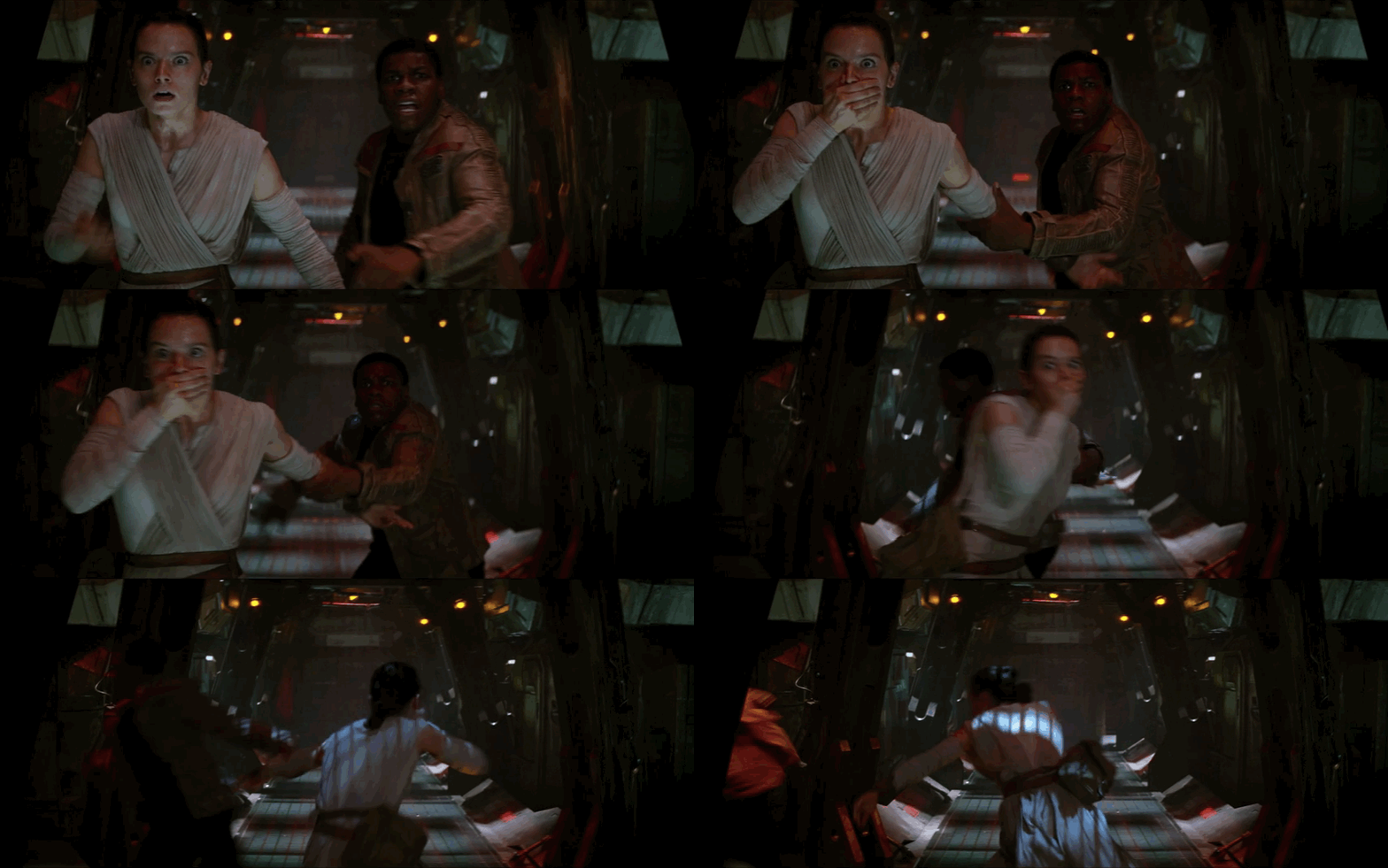
And 18 where not white. So when it comes to choosing just a few characters, the Nobel committee tends to pick them male and Caucasian, even in 2017. However, as the tale of Rey and Finn tells, the hero figure is not an exclusive of white dudes, if there is a will to tell the story of others. But this is a much larger issue than what I wanted to discuss here.
Another criticism aims at the fact that the prize only goes to senior researchers, instead of the young guns, who are really toiling in the trenches. But this is a problem only if we intend our Nobel Hero as the solitary pioneer whose brain pulls science forward. Here, too, Star Wars can… ehm… give us a hand.
[Spoilers coming if you haven’t seen the original trilogy]

Luke couldn’t have destroyed the Death Star without the help of a squadron of X-wings, the Millennium Falcon swooping in, and the whole ordeal told in Rogue One. Yet, at the end only Luke, Han, and Chewbacca get honored. Because it doesn’t really matter who materially dealt the final blow. It matters what they represent. Luke personifies the Rebellion’s values of courage, loyalty, and self-sacrifice. At the beginning of Last Jedi, Finn proves that heroes are but humans (with human flaws), but with deep significance for their community. Because they represent something, something important, and they earned that distinction.

Much the same way, the Nobel laureate is first and foremost an authority figure. He (99% of the time) is not just a star among nerds, he has the ear of the powerful, for example at international summits. In that sense, having just a few is for the best. First, investing that authority in thousands of people every year would inevitably dilute the prestige of the prize and the authority itself. Second, these figures are there to represent scientific progress. They are ambassadors of the scientific community in the world. They don’t need to be many.
How unfair we find the selection of these heroes, then, depends a bit on how we intend them. Some undeniable problems–for the Nobel prize as much as for Star Wars–can be solved expanding a tad the horizon of the stories we choose to tell (like, beside those of old white dudes). Other problems can be solved re-examining the role we give to heroes in our adventures. Star Wars managed to take both roads, the Nobel committee can only balance their hero picks–and must be pressed to do so. The role we give to heroes is up to us, as it was up to Rose. It’s a movement that comes from each of us. Like the Rebellion.
If you want more
- Brady Haran and CGP Grey discussed role and number of Nobel laureates in a nice episode of their podcast Hello Internet
- Here’s the official procedure used to select physics Nobel prize winners
- If you want to dig deeper in the cultural value of Last Jedi, there was an argument on Slate about its relation with fandom and mythology
- Then Crash Course swooped in with this super-complete analysis on mythology and psychology
 PhysicalLove