
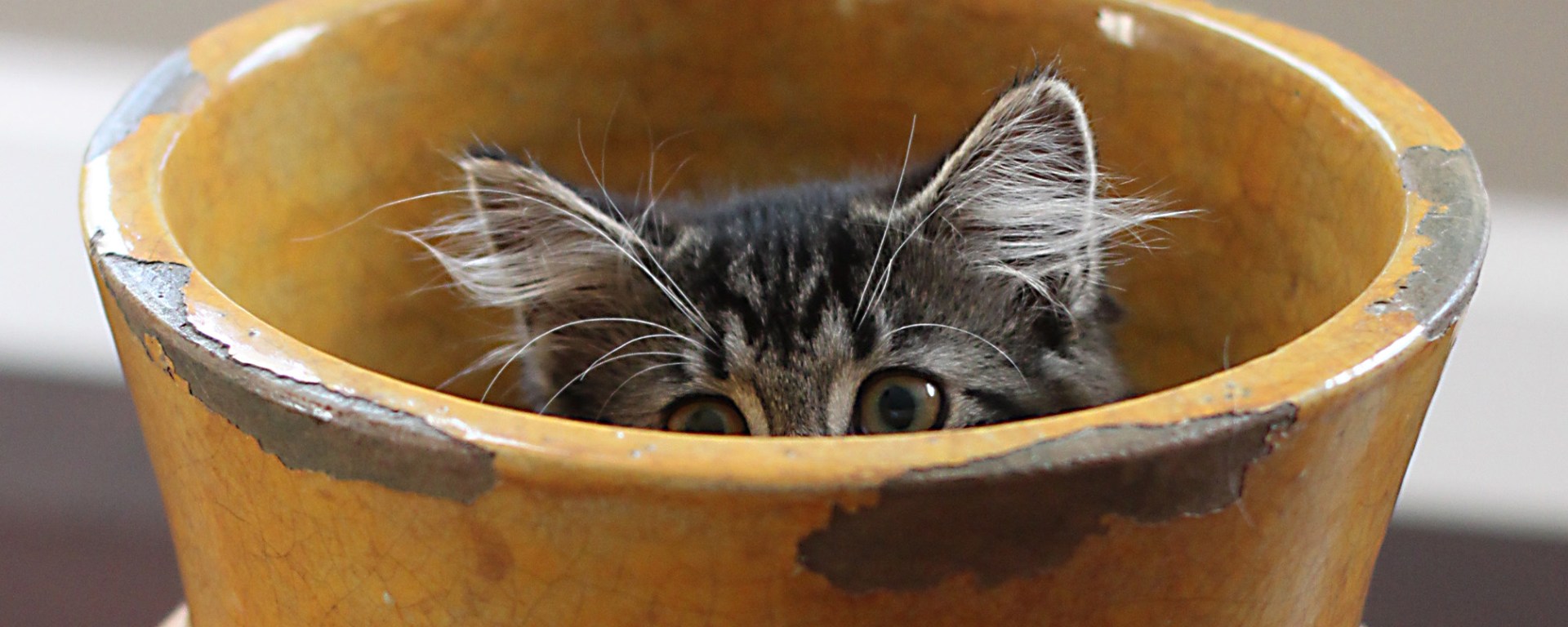
If you try to sit on a pond or drink a chair, you’ll quickly realize there’s a significant difference between solids and liquids. The rule of thumb I learned in school is that a liquid takes the form of its container. Then again, that would make this cat a liquid.
So the line between liquids and solids is a little more blurred than we’re told.
The ability to adapt to the shape of a container, in fact, is a consequence of the defining feature of liquids: they flow. Put a bunch of rocks in a vase and they’ll just sit there, one on top of the other, resting on each other and on the sides of the vase. They sure won’t flow, so they’ll keep their original shape. Water molecules, instead, slip one on the other and along the container walls, rapidly filling all empty space.
Things get more complicated with pitch. It looks solid enough if you try to smash it with a hammer. However, a famous Australian experiment shows that pitch flows and even drops. At the pace of a drop every 14 years, but it does.
Basically, a material can be liquid or solid depending on how long we’re willing to wait. Pitch can be fairly solid for the next five minutes, but will flow in the next five years. The Earth’s mantle (the layer just below the rocky crust we inhabit), for example, is millions of times thicker than pitch–literally rock solid. Yet, in geological times it flows, just like a liquid, causing continental drift.
Defining what’s liquid or solid, then, isn’t an easy task. Cats (for which the jury is still kind of out, by the way) maybe aren’t the best of examples to test the definitions, since observation time is limited. Also, they’re not always that cooperative.

If you want more
- A persistent rumor says that glass is a thick liquid, and that old stained glass windows are slowly flowing to the ground. Several studies showed this to be a myth. One, in particular, concludes “window glass will only flow appreciably at room temperature if one waits until the Second Coming“.
- A research actually did investigate the flowing properties of cats, to see whether they are–physically speaking–liquid. And since the question seems silly but turns out to be interesting, it won the IgNobel Prize for physics,
- Just want to look at cute pictures of “liquid” cats? Here you go.
Cover photo: Maisie Vase, CC-BY-NC drocpsu/flickr
 PhysicalLove
