
Awarding the Nobel prize for physics to something related to gravitational waves was a matter of when—not if. Still, one could have argued it was too early: gravitational waves were not a surprise discovery.

I myself played the contrarian and argued for this, using as comparison the other great discovery of this decade: the Higgs boson. The Nobel for the boson’s discovery, in fact, was awarded to two theorists, once their smart idea was confirmed experimentally. Notably (and questionably), the prize did not include the CERN collaborations behind that confirmation. In the case of gravitational waves, the theoretical discovery was mostly Einstein’s, who, being dead, could not win. So why would you award the prize to gravitational waves?
Well, there’s a fundamental difference. With the Higgs boson, scientists knew how to look for it—build a ginormous accelerator—but not whether they’d find anything. Higgs and Englert’s was a brilliant theory, but could have been completely wrong. With gravitational waves it was the opposite: scientists expected to eventually find them (general relativity is pretty established), but not how to search for them.
So Weiss, Barish, and Thorne decisively contributed to build an instrument to measure something nobody had figured out how to measure. And it was so good an idea that other gravitational waves observatories (like the European eLISA) follow the same basic design. That’s why it’s worth a Nobel.

As for my pet candidate (exoplanets) I guess I’ll keep waiting, just like I did for Dylan’s literature prize.
If you want more
- Why wasn’t the whole LIGO team awarded the prize? And neither the CERN people who discovered the Higgs boson? Because the rules to pick winners are rotten.
- More people than I care to list wrote and talked about gravitational waves these days. So I’ll just point out a few things of mine: this one for the basics, this one for a report of the story, and this one (with puppies!) for those who want to dig deeper into a couple of details. And the enormous resources of the LIGO website.
- There’s, of course, also plenty of good YouTube resources on this: Veritasium did a great video to look into the absurd difficulty of detecting gravitational waves; while this PBS Space Time video is—in my opinion—just the best, most complete (while somewhat accessible) description around
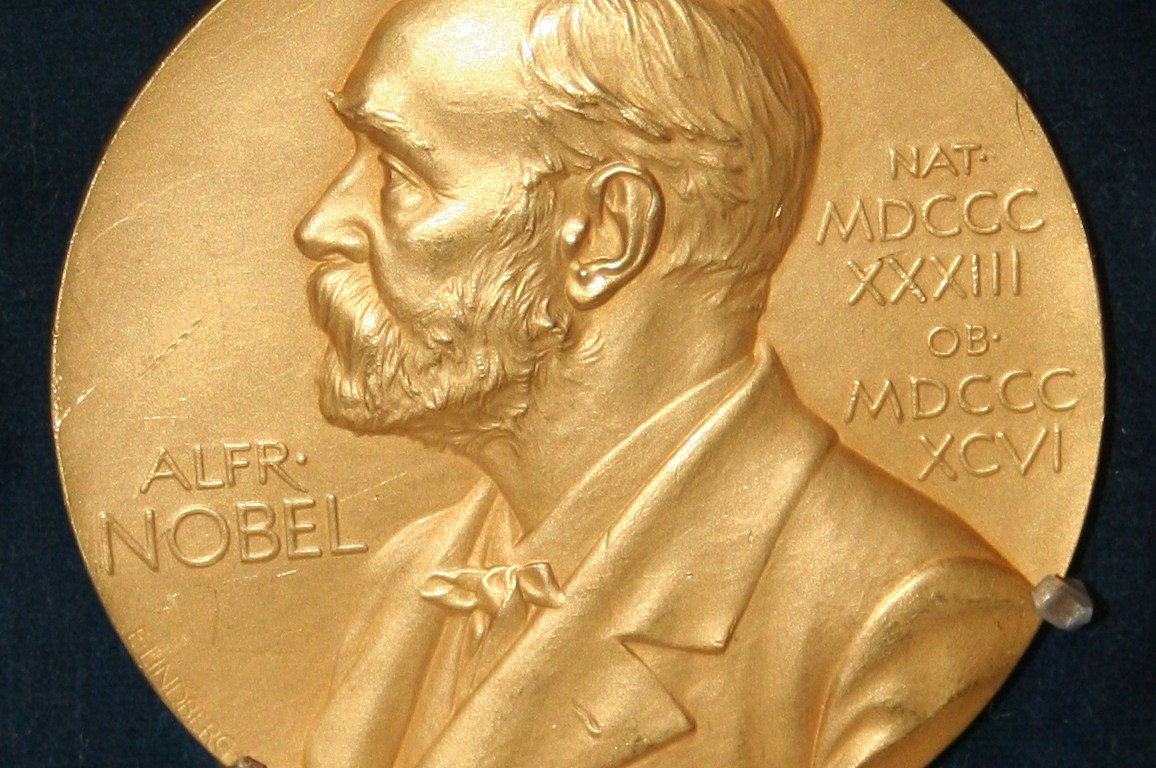
Cover photo:  Front side (obverse) of one of the Nobel Prize medals in Physiology or Medicine awarded in 1950 to researchers at the Mayo Clinic in Rochester, Minnesota. CC-BY-SA – Design of the medal: Nobel Foundation
 PhysicalLove
One thought on “Why LIGO won”