
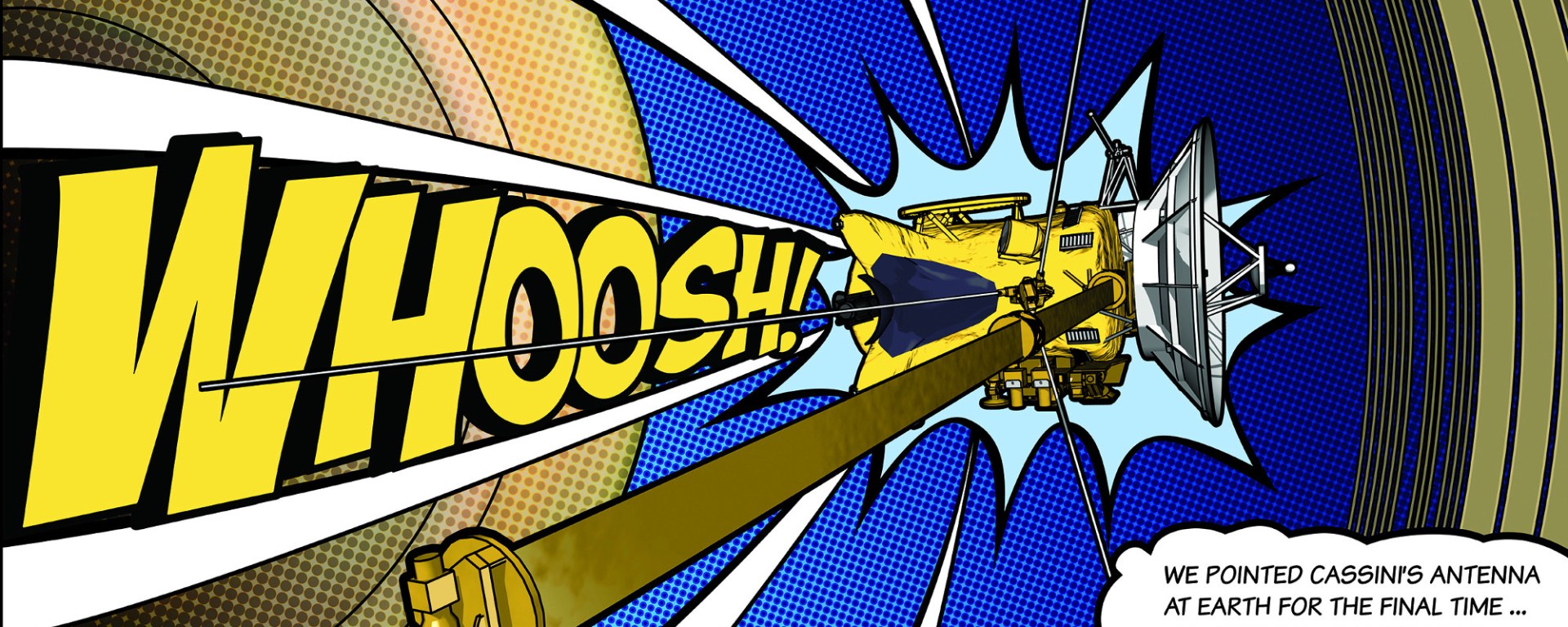
20 years after it launched, the NASA spacecraft Cassini ends its mission today. Its 13 years in orbit culminate in one last mission: to dive into the planet’s atmosphere, while still measuring and transmitting data.

Named after Italian astronomer (and Saturn fan) Giovanni Domenico Cassini, the spacecraft is about 7 times 4 meters big—think two large vans parked side by side—for about 2000 kg of mass (so less than one van). It launched in 1997 from Cape Canaveral, and arrived at Saturn in 2004, carrying the European probe Huygens, which promptly landed on the planet’s largest moon, Titan.
Chances are, if you heard anything about Saturn more detailed than “it has rings”, that info comes from Cassini. The features of the north pole hexagon, the pictures and characteristics of the moons, the composition of the rings: that’s all Cassini’s work.
Cassini’s initial observation mission ended in 2008. But its great success pushed NASA to extend it to 2010, then again to 2017. In this extended time, Cassini allowed scientists an unprecedented close look to the then-mysterious planet. It witnessed the rise of an enormous storm and visited all the moons.


Thanks to Cassini, we now know that the rings are made up of chunks of rock and ice ranging from dust-grain to mountain size. We saw towering features rising for kilometers above the edge of rings, probably stirred up by the gravity of big boulders orbiting close by. We solved the mystery of the origin of one of the rings. Which, by the way, is that Saturn’s moon Enceladus is spray-painting it by spewing out vapor and ice.
Speaking of moons, Cassini studied all of major Saturnian satellites from up close, in all their diversity, kickstarting the search for life in the solar system, as well as out of it. Before Cassini, the search for habitable planets often meant searching for Earth-like planets. The probe added some completely new classes of bodies to the mix. Its observation of Enceladus—which produced fantastic new results right this year—spurred us to look at similar ocean-covered exoplanets, as well as icy moons (like Enceladus itself or Ganymede). Titan, instead, looks quite a bit like Earth: it has dunes, weather, rivers, lakes, oceans but with hydrocarbons playing the part of water. It surely isn’t something we would have deemed “habitable” 20 years ago, but with all that carbon going around it’s actually a good candidate for life.
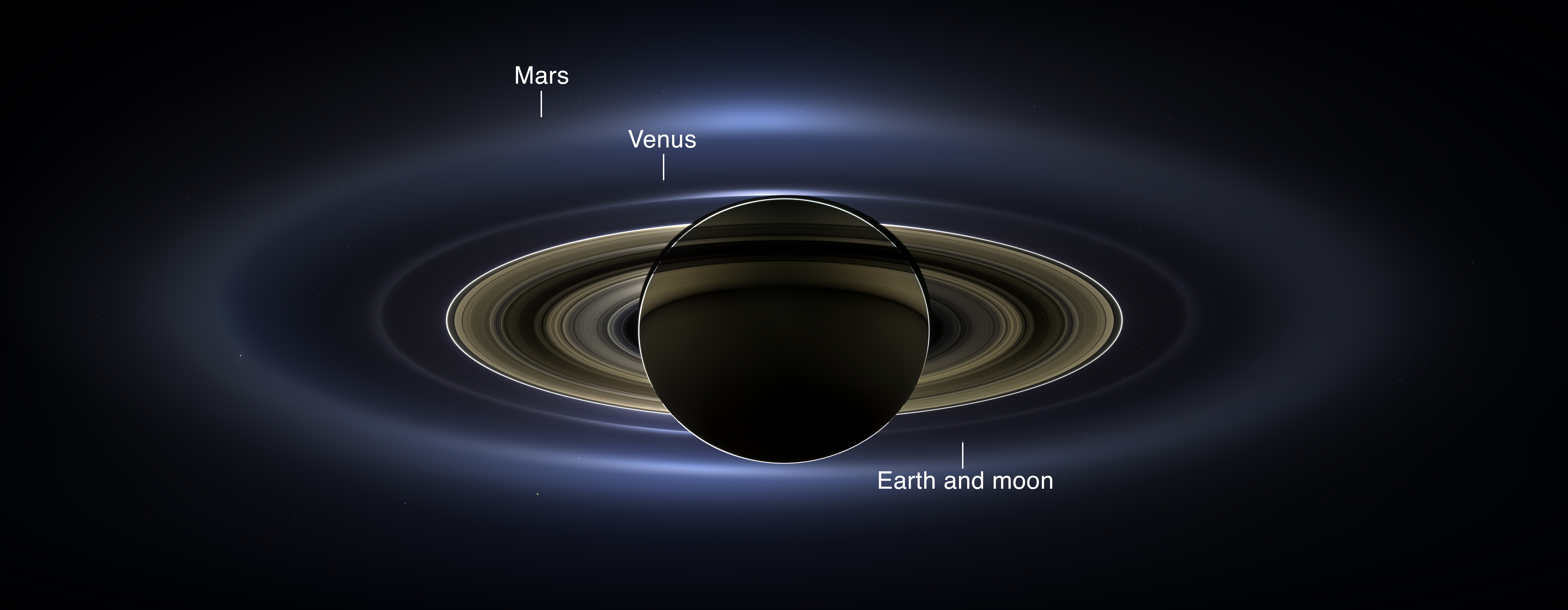
We can also thank Cassini for witnessing and relaying to us a spectacular storm rising from the depths of Saturn’s atmosphere, or for the discovery that the days on the planet have a weirdly irregular duration, or because the resource sharing necessary to make Cassini work turned into a model for other cooperations in space and on Earth, including carbon trading.
If it’s so successful, why end it? Can’t the craft keep on studying the planet it now got to know so well?

Cassini’s orbits and orientation are adjusted using tiny rockets, which almost emptied their tanks by now. If the tanks emptied completely, NASA couldn’t control the craft, and there’s a tiny chance it would crash on one of the moons. Since they are a pretty good candidate for life, and Cassini is probably teeming with our gross Earth germs, we don’t want to contaminate them, just in case there’s actual native life to discover there.
So NASA devised a plan, which they soberly named The Grand Finale. They turned the craft’s antenna towards Earth and plunged Cassini into a series of 22 ever-tightening orbits, starting in April. As it spirals down, the craft is still measuring the planet. Today it will enter the atmosphere, still doing and transmitting its science till the very last moment when, inevitably, it disintegrates like a meteor.
If you want more
- There’s the usual giant information load on the NASA website, jam-packed of beautiful images, videos and all sorts of resources
- Particularly, a short article on 9 reasons why Cassini matters, a few of which I covered here
Cover photo: NASA/Jet Propulsion Laboratory-Caltech
 PhysicalLove