
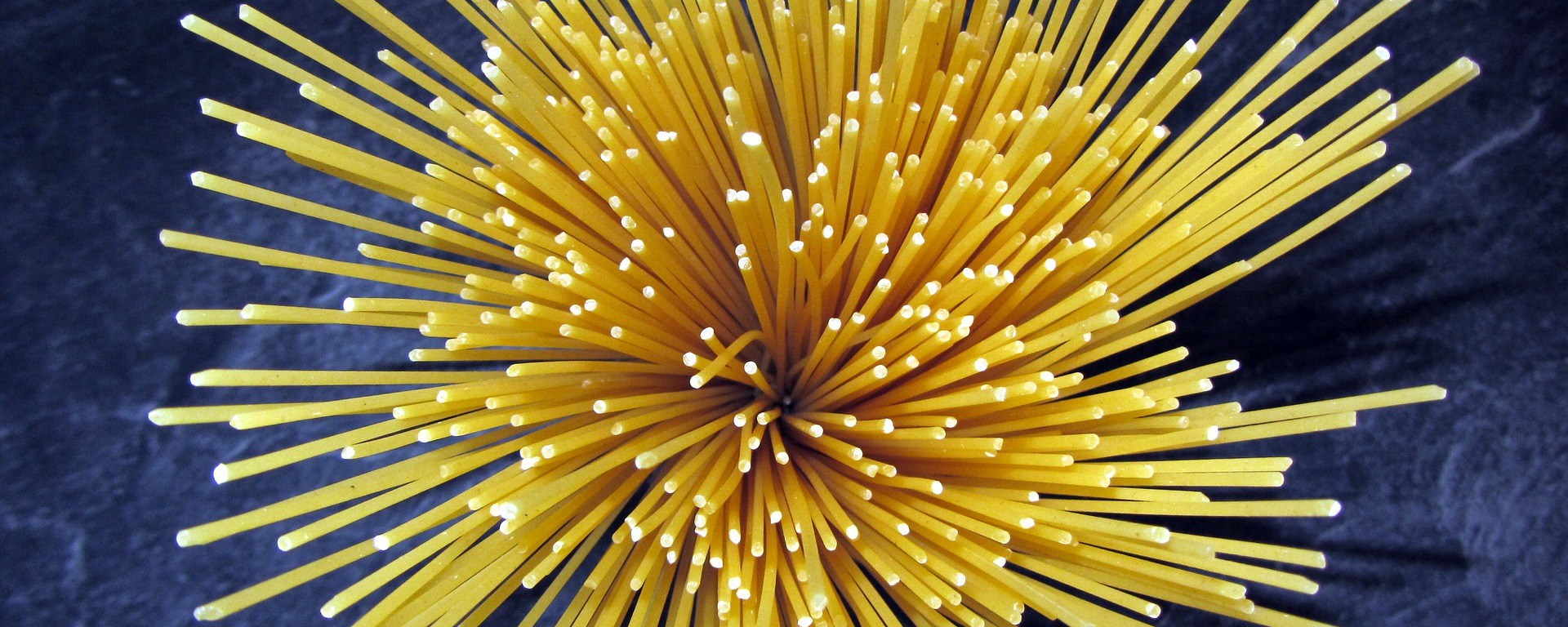
If you grab a piece of spaghetti and bend it further and further, it will eventually break. It won’t just break in two, though: most likely it will break in three or more pieces. What sorcery is this?
Don’t believe me? Be a scientist: try it yourself!
Why spaghetti break the way they do turns out to be a really hard problem, that stumped even legendary smart person Richard Feynman.

Indeed, it wasn’t until 2005 that someone figured out a solution. Which still nobody saw in action until 2014 (!!!), when YouTuber and all-around cool guy Destin Sandlin finally cracked the case (get it?) in this video:
There’s a good reson nobody figured this out earlier: it’s freaky!
Clearly, if you apply enough force to a piece of spaghetti, the tension will make it fail somewhere. When that happens, the piece will try to straighten back, starting from the fracture point (where it’s free to move).
If the piece is short, the fracture is really close to your fingers, and the spaghetti will basically snap back straight. But if it’s long enough, it will straighten so fast that it creates tension with the part you’re holding, which is still at an angle. So the spaghetti breaks again.
So it’s the opposite of cascading fractures, where one failure shifts more load on the remaining parts, breaking them. In the spaghetti, only the first break happens because you’re applying too much force on the spaghetti. The others happen because the force comes off.

Bet you weren’t expecting to have such cool physics and engineering in your kitchen cupboard.
If you want more
- Studying this stuff is important to understand how and why materials behave the way they do. And there’s plenty of scientists doing that
- You can find the real actual science paper on breaking spaghetti here
 PhysicalLove