

On the 30th of September 2016 (today if you read this post as it comes out), the great Rosetta mission of the European Space Agency (ESA) will come to its conclusion.
It was a long mission, featuring an epic decade-long high-speed chase across the Solar System, after which the Rosetta probe (which gave the name to the mission) hit its target orbit around comet 67P Churyumov/Gerasimenko. This made it the first object we ever put in orbit around one of these space snowballs. From there, it studied the comet from close-up, then released a lander, called Philae to touch the surface for the first time in history (you can listen to that momentous instant here).
As the comet moves away from the Sun, however, it’s becoming too cold and dark for Rosetta to operate. In a Viking-funeral-like ending, the mission will terminate by crashing the probe on the comet. As a send-off, here’s a little look back at what Rosetta has meant and what it has discovered.
Since we’d never been that close to a comet, the Rosetta probe and Philae had a lot of answers to provide: what are they like? Is it true that our water came from there? and many, many more.

The surprises started immediately. Astronomers were expecting the comet to look more or less spherical, or potato-shaped, like most asteroids. Instead, already on the very first pictures, they saw a rubber ducky. Apparently that’s what you get from cosmic collisions in super-slow motion. The two lobes of 67P are smaller comets, with very weak gravities, crashing into each other veeeery slooowwly.
One of the big quests for Rosetta was to look at the ice on 67P and tell us whether comets really could have brought water to Earth. Though that seemed to be really likely, it soon turned out that it isn’t the case. The mixture of hydrogen types over there doesn’t match the one down here. Our water came from somewhere else. But comets do carry tons of oxygen around them, and even the basic building blocks for life, including carbon-based compounds, phosphorus and amino acids.
Many of these results couldn’t just come from flying around the comet we had to actually touch it, scratch it, drill it, and measure it. That was the job of little lander Philae, which was… er… a less-entirely-positive chapter of the story. Still, it did everything it was supposed to do, just none of the “bonus credit tasks”.
Mostly, that’s because the landing (admittedly hard to nail as it was) went, quite frankly, just wrong. Philae bounced around a couple of times, ending up wedged between rocks. It was lost, and the shade prevented its solar panels to recharge the batteries. Yet, the brave lander rapidly carried out its experiments, sent out the data, then shut down. Apart from a brief moment in June 2015, Philae never came back and was never found until the very last moment.

Rosetta gave us a lot of new data and a new look on comets. It told us what things we see in observatories “down here” actually mean “over there”, on the comet. Now we can also look at other comets through this experience and learn more. In a way, as they said on StarTalk, it’s as if we visited more comets in one.
So thanks, Rosetta and fare thee well!
Cover photo: An artist impression of Rosetta in front of comet 67P, from ESA.int
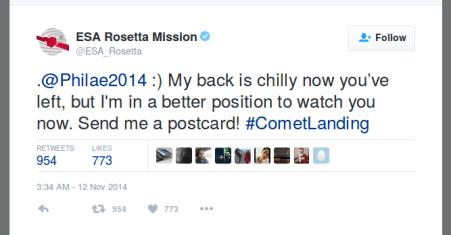
PS: Despite a couple of disturbing messages to Philae, the Rosetta’s Twitter feed has been—and continues to be—a great source of fresh news and stunning pictures from the mission. The people at ESA did a great job. Go check it out!
Bonus: if you have kids and want to get them involved in space stuff, there’s also a fantastic series of brief cartoons on YouTube that tells the story of Rosetta. Another great job from the ESA communication team.
 PhysicalLove